Sunday, May 15, 2011

First Crops, First Markets


Finally, after what seemed like an endless succession of cold rainy weeks this spring, we were blessed with an absolutely gorgeous week of sunshine and moderate temperatures. Needless to say, we scrambled to try and catch up on all the planting and seeding that we have missed due to the wet conditions.
Beautiful crop of dandelions on a perfect spring day

This year's crew stepped up to the task and cranked through seeding the peas, potatoes, and the first field plantings of lettuce, spinach, boc choi, broccolini, Asian greens, salad turnips, escarole, radicchio, fennel, scallions, and cilantro. By the end of the week the soil was actually starting to get dry, so the showers and rain this weekend were welcomed, rather than sworn at, for a change. With all the rain early in the season, irrigation set up has been a very low priority.

The late start of the planting season will mean a delay for many of our crops at market, but at least we got them in the ground. The peas will be a bit of a crap shoot this year. Normally, they must be planted by mid to late April to have any chance of being productive. If the weather stays on the cool side, we may get something out of them, but if it heats up, it will likely be a loss.

Opening Saturday at the Saratoga Market

Farmer's market season started for us on May 4, so we have already had four of them. Opening day was a cold and rainy Wednesday, and a contender for perhaps one of the slowest markets I can remember in the past twelve years. Despite the awful conditions, we had a respectable showing of our most dedicated customers and we thank them for their enthusiastic support.

The later markets were a vast improvement in weather conditions and customer attendance. Our stand feels a little sparse since we have had to rely, solely on our limited production of greenhouse greens, but we have had some beautiful arugula, mesclun, and lettuce mix along with sprouts and an assortment of garden vegetable starts.

The new and improved stand set up

Our stand also looks a little different this year. We have struggled a long time to simplify our stand set up. We wanted tables that set up quickly with little fuss and displayed product well. This winter we took our ideas to our long time friend Ed Woods, who is a master woodworker. He magically brought ideas to reality, designing and building a prototype. The result is a series of folding tables with a lift-up slant top. So far we are very happy with the new design, although we are still trying to adjust to the new layout. Thanks Ed!

Come visit us at the market sometime soon. Wishing you all sunny days...and just enough rain to keep you hydrated.

Sunday, April 24, 2011

April Showers Bring ... Anniversaries and Mud

Man, it’s been a long time since I’ve written a blog. In fact, it seems like a long time since I’ve farmed too. Despite the long hiatus, we are back and ready to roll. To pick up where we left off last summer in July…Tammara and I took a much needed sabbatical away from the farm and Tammara’s regular full-time job to travel across the country. We spent nearly three months camping, hiking, and canoeing through the US and parts of Canada. It was a trip of a lifetime that we feel truly blessed to have been able to do. If you are interested in the trip, itinerary, and our experiences, our companion blog www.vagabondfarmers.blogspot.com is still up on the web, so feel free to peruse.

In our anniversary finery


After returning home in late October, Tammara returned to work, and I returned to fall chores and planning for the upcoming season. Our trip clarified our desire to keep farming and reaffirmed what a beautiful and fertile part of the world we are lucky enough to live and work in. This will be our thirteenth season farming at New Minglewood Farm. This April was also our 25th wedding anniversary…both of these milestones are hard to believe.

This spring has been a trial of patience. After a long snowy and cold winter I think everyone is pretty anxious for spring to arrive, but after a couple of false starts, it seems we are back to March like weather. With many cloudy cold days with frequent showers and rain, the soil on the farm has remained saturated. If you are lucky enough to farm on soils on the sandy side, you may have been able to plow some ground in early April, but here at Minglewood Swamp with its heavy silt and clay soils, we have been patiently (or not) waiting for it to dry out. The problem with trying to work soil when they are too wet is that you will compact the soil and just make a mess. So, you just have to wait. Finally, last Friday I couldn’t take it any more. Heavy rain was predicted for Saturday, so this was probably the driest it would be for the next week or so. I went over the fields lightly with a chisel plow, just to rip up some of the rye cover crop and expose more soil surface area, in hopes of facilitating more drying. I don’t know if it did much good, but I sure felt better driving around on the tractor.

Despite all the frustration of trying to get anything planted in the fields, we have been quite busy in the greenhouses. We were able to get some early lettuce planted in the fieldhouse, along with some early season tomatoes. We are also on schedule with the baby greens and with lots of transplants for the farm and for sale. We’ve also been busy getting this years mushroom logs inoculated with shiitake spawn.

Baby arugula


Lettuce plugs waiting for transplanting


Eggplants and peppers getting ready for your garden


Oak logs freshly inoculated

The Saratoga markets start in May, opening day this year is a Wednesday, the 4th. We are looking forward to returning and seeing lots of friends and customers. As in the past, we will also be offering our Minglewood CSA Dollars option once again. Rather than a traditional CSA, where you receive a box of produce every week, this option allows you to pre-buy a share of produce, which gives you a credit at our stand at the farmer’s market. When you shop at our stand we simply deduct the sale from your credit. Savings are based on a sliding scale of 10 to 20%, depending on how much you pre-buy. This allows you to buy what you want, when you want it, and save money. Pre-buying early in the season helps the farm with springtime cash flow, but you can buy shares any time during the season. See us at the market for more information, or e-mail us, and we can send a flyer.

Happy spring!

Tuesday, August 3, 2010

Silence

Today the farm is eerily quite. The walk-in cooler and greenhouse fans are finally shut off, the fields have all been harvested, tilled and seeded to cover crops, and the greenhouse beds are empty. The food bank crew came today and harvested what little was still left in the field.


The farm feels like it's the end of October, but the thermometer reads about 85- so that can't be right. If you have been following this blog you will know that Tammara and I are taking the second half of the season off to take a long needed extended vacation (sabbatical). Our plan is to drive across the country to camp and hike in National Parks in both the US and Canada. To find out more about this trip visit our new travel blog at Vagabond Farmers http://vagabondfarmers.blogspot.com We plan to start making posts to the site in the near future.
We must admit we were quite nervous about the reaction our customers would have toward this plan. We need not have worried, everyone we have told about the trip has been very supportive and genuinely happy for us. Granted, there is typically a brief moment of anguish when they realize there will be no Minglewood tomatoes and they will have to find a new source for salad greens and arugula, but then most people say "Good for you" - and then start telling us about all the places we have to visit.
We would like to thank all our dedicated customers for their understanding and assure them we will be back in the spring of 2011 with renewed energy and enthusiasm for farming. We would also like to thank this years superb crew both at the farm and at the market. With the reduced number of crops we were trying to manage the farm never looked better, and despite having less variety available at market, our sales were still 10-20% higher each week than in previous years.
Enjoy the rest of the summer, and stay in touch.

Tuesday, July 13, 2010

Hot, Hot, Hot!!!

Wow! What a hot spell we had last week. Temperatures were well into the 90's with hazy sunshine and no rain - these are not good conditions for a lettuce farm. Actually, the lettuce managed okay, at least compared to the spinach and and baby mesclun greens. There is a reason these greens are sometimes sold as a 'Spring Mix', because spring weather conditions are when these greens really thrive. In the heat they get very stressed out (much like the farmer), and just want to bolt, or go to seed. There's not much you can do about the weather, but we did get the irrigation up and going again. I don't think I had needed to use it for at least the month previous to last week. Watering helps, but really is no substitute for a good shot of rain. It seems that no matter how much you water, the ground is dry again within a day. We did get a brief downpour on Saturday morning, as we were loading the truck to go to market, of course, but it cleared up later that morning. This was good for the market - not so good for the vegetables.
If you think it was hot outside, you should have checked out the greenhouses. It had to be at least 110 degrees inside, reminiscent of a sauna, but with 99% humidity. It was literally hard to even breathe in there, let alone try to work. We did manage to get the week's salad greens planted in the greenhouses, but it was so hot many of the beds had very poor germination and had to be re-seeded later in the week.
To try and cool things down we covered the greenhouses with shade cloth. This is a woven mesh that goes over the whole house and blocks out a percentage of the light. Some seasons I have not had to use it, but when it gets into the 90's there really isn't any choice. It does make it a little cooler inside and you don't need to water as often, but on the down side, the greens tend to stretch for the light and become a bit 'leggy', and there is also more tendency for 'damping off'.
It's always an adventure to get the cloth on... that really was one hot tin roof!
Believe it or not, things have started to wind down on the farm. With only three weeks until we leave on our sabbatical, the last of the lettuce and other transplants have been planted and the final seeding of greenhouse greens went in last week. So for now it's just weed, water and harvest. Oh yeah, I guess there is some cleaning up that needs to happen too.
The selection of produce at our farmers market table is still going strong, but we have probably seen the last of the peas and radishes. Spinach is holding in there, but just barely. Lettuce and salad greens, scallions, escarole, boc choi, and sprouts should continue to be abundant.

Monday, June 28, 2010

Solstice Crops and Organic Inspections

Happy summer! I guess it's now official as of last week, although it certainly feels like it's been summer for some time now. All the rain and warm temperatures have continued to push the season right along and all the crops are growing like bonkers. Our perennial gardens around the house are in full bloom; iris' are just about done, but the day lilies and cone flowers have filled in. Tammara planted a new bed last year and it has been a joy to see new blooms nearly every morning. Here's one of our favorites- a peach colored double day lilly.
Escarole is one of the new crops we have started to harvest in the past week or so. For those not familiar with this green, it is a wonderful Italian cooking green in the chicory family. It looks a lot like lettuce, but is generally a bit too bitter to eat raw. Steaming or sauteing it mellows the flavor and makes it the perfect ingredient for traditional "beans and greens".
Scallions are also back on the market table recently. The crop looks good this year, tall and robust, but not too fat. These are great chopped on a salad or added to your favorite stir-fry.


Spinach continues to do well, with no sign of the spinach blight that took it down last year. The long hot days are starting to force older plantings to bolt (go to seed) faster than we would like, but hopefully by planting new beds every week we will continue to have a good supply.

Snap peas have been a bit of a disappointment this year. I planted 400 row feet of Sugar Ann peas and had less than 5% germination. I am convinced it was bad seed and not attributable to the weather or pests. On the same day I also planted 200 feet of Sugar Snap peas which came up fine. So we have Sugar Snaps, but no Sugar Anns. Unfortunately, the Sugar Anns are a much tastier, productive and manageable variety. Sugar Anns grow to about a three foot vine which is easy to trellis and loaded with peas. The Sugar Snaps grow to six or seven feet and are now a tangled jungle mess with far fewer peas. It's quite the adventure just to find a hand full of peas. We use the buddy system when we go to pick them so we don't loose anybody.
Crops which are done for the season include brocollini (Chinese kale) and salad turnips. We will miss them and look forward to eating them again in 2011. We should have most of our other standard crops through to the end of our short season.
On a different front... today we had our annual organic certification inspection. The purpose of the inspection is to make sure all our records are in order and to verify that the farm is in compliance with the federal organic regulations. We have been certified since 2002, so after eight years we pretty much know what to expect and the process doesn't take more than a couple of hours. I've actually grown to enjoy the process - the feedback is generally positive and it's sort of a pat on the back that we are doing a good job.
The process of review has forced us to become better organic farmers. Through our record keeping system we must track every crop from seed to sale. This means you must document where you bought the seed, where and how you planted it, when and how you fertilized it, if you used an allowed treatment for pests or diseases, when you harvested it and where you sold it. It's a lot of paperwork to keep track of, but it's all important information that you should keep anyway and will help in planning future seasons.
At present we are the only certified organic farm selling at the Saratoga Farmers Market. I honestly do not understand why more farms have not gone through the process. It does take a bit of time for the record keeping and it does require a fee (about 1/2% of our gross sales after a NY State rebate), but I believe it is the best assurance to the customer that what they are buying is really organic.
Well, this week looks like more rain and showers. Hope you all stay on the dry side.

Sunday, June 13, 2010

Tweleve Step Program... to awesome salad greens

By mid-June the weeks on the farm have fallen into a fairly predictable routine: Monday - get the tractor work done, soak sprout seeds, soak mushroom logs; Tuesday - renovate greenhouse salad beds; Wednesday - harvest and go to market; Thursday - seed flats and soil blocks, transplant, weed if there's time; Friday - harvest all day; Saturday - go to market, come home and collapse; Sunday - sleep, read... catch up on everything you didn't get to during the week.

One of the biggest and most critical jobs on the farm is salad green production. It is quite the process and consumes half a day for two people every week of the season. From the start of our farm we have always produced baby greens in raised greenhouse beds. We feel that the quality and consistency can not be matched growing them outside. This quality does come at a cost, the quantity that can be produced is limited by greenhouse space and it's more expensive in labor and materials for production. However, the advantages include less dependence on the weather, better control of bugs and diseases, and no weeds to deal with.

This system is the key to our salad mixes and is the reason why our greens really are different from most other producers. In the greenhouses we grow arugula, tatsoi, red mustard, green mustard, mizuna, and baby kale. Some of these greens we sell individually and others we mix in with field-grown lettuce for mesclun. Here is our twelve-step program to awesome salad greens.

Tuesday mornings start out by re-cutting any greens that have grown back after the previous weeks harvest. We could increase the yield of this second cutting if we left the bed to grow a little longer, but overall yield in the greenhouse is actually better if establish a new seeding instead.


Next we use a flat shovel to clean out the top inch or two of plant stubble and roots. The tailings are piled outside to re-compost and eventually get spread on the fields.

Next, the old sub-layer of compost left in the bed is loosened and chopped up with a hoe.


Then fresh compost is shoveled into a wheelbarrow to re-fill the beds. Each season we get a huge truck load of compost delivered from the Vermont Compost Company. Their quality and consistency is excellent. We use their compost for the green house beds, as well as, for making our own potting mix that we use for transplants.


A load of compost is dumped in each bed. Each week we renovate 11 beds, which is a quarter of our capacity (44 beds in total).


The compost sub-layer is raked smooth.


Next, we start mixing ingredients for the top layer. This includes compost, peat moss, perlite (a natural mineral that provides aeration) and a natural fertilizer blend (North Country Organics). Ingredients are put in a portable cement mixer to thoroughly combine.


Loads of the mix are dumped on each bed.


And then raked and smoothed evenly over the sub-layer of each bed. If they are not level and relatively free of clumps, it makes it difficult to use the seeder.


A pinpoint seeder is used to evenly and consistently seed each bed.


Beds are then watered,


and covered with floating row-cover. The fabric helps to keep the beds from drying out while they are germinating. After three or four days the covers are removed for full light and air circulation.

If all goes according to plan, after one week the bed will look like this:


And after two weeks, this:


And after three weeks, it should look like this, at which point it is ready to harvest, and then the whole cycle starts again, week after week...
Hey, what do you know, that really is twelve steps!
Well, it's Sunday... where's my pillow?


Sunday, May 30, 2010

Selling Out

Wow - what a crazy month! I can't believe it's Memorial Day already. The season has started off with a tremendous bang this year. I guess the local food movement has really taken hold in Saratoga Springs; we've had some of the busiest markets ever. In fact, the past two Saturdays have grossed more in sales than any of our previous markets - ever. We have had a hard time keeping up with demand, selling out of most produce well before the end of market. Fortunately, with all the warm weather our production has finally started to kick in and this past week we at least had salad mix until the closing bell.
We have had a nice selection of spring crops to offer: lettuce, spinach, arugula, baby boc choi, stir-fry greens, salad turnips, radishes, broccolini, cilantro, sprouts, and shiitake mushrooms. We should continue to have most of these crops for the next few weeks, although broccolini may be about done - with the summer heat it all budded at once. Snap peas, scallions, and escarole are still a few weeks away.
Apparently, everyone in Saratoga is also putting in a garden this year. Plant sales have been incredible so far. In the past two weeks we have sold over a thousand tomato plants - which is far more than we've ever sold in the past. Sales have also been vigorous for peppers, eggplant, lettuce, and herbs. We really appreciate and thank all our dedicated customers for coming out and supporting the market and our farm. The market has been crowded and hectic this year, making it difficult to give customers the attention and service that we ideally like to provide - thanks for your patience and understanding.
Back on the farm, things have been busy too. Due to our abbreviated season this year, we have really tried to scale back on labor, to reduce costs and balance out our reduced income. Thankfully, Martin B. has returned for a third season and is doing a great job keeping the farm going. So far between the two of us, we have managed to keep up with all the greenhouse seedings, transplanting, and harvesting. Unfortunately, there has not been much time for weeding, and this has finally started to catch up to us - maybe this week...
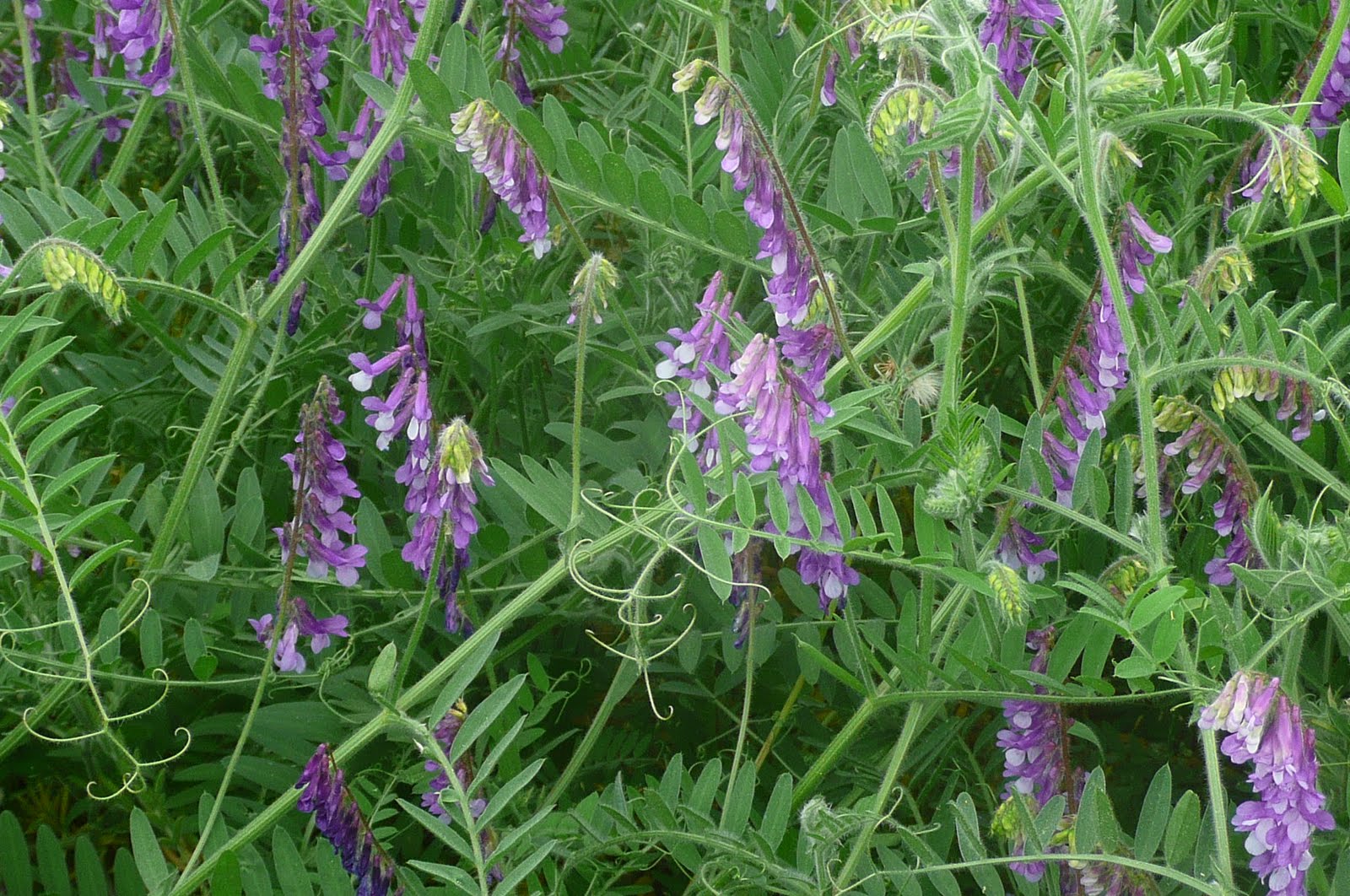
Finally today I had a chance to do some much needed mowing. This is actually a pleasant way to spend a Sunday - there is a certain Zen quality to the slow progression back and forth through the tall fields (despite the diesel fumes). Below is a photo of an absolutely beautiful field of flowering vetch, just before I mowed it. This is the same field that was 'frost seeded' to clover and and annual rye in March. The vetch was seeded in the late fall the previous October and I didn't think too much of it had made it though the winter, but wonder of wonders, it all took off later in the spring. I did not find too much evidence of the clover/rye, but that's okay, vetch makes a pretty nice fallow season crop as well. I hated to mow it, it was so nice to look at, but I was afraid to let it go to seed and potentially become a weed problem in future seasons.


Mowing also gives you a chance to see things on the farm that you would not ordinarily see. While mowing an adjacent area I narrowly just missed running over this little guy...


Thank God I saw him in time... the Wood Turtle is one of my all time favorite creatures. They spend some of their lives in water, and some on land, thus the name. Unfortunately, they love to wander around in the tall grass on a warm summer afternoon. We figure this guy we 15 to 20 years old, based on the rings of his shell.


Well that's all for now. Enjoy the summer weather, walk bare foot through some tall grass, just watch out for the mower.